The Box for a Pistol Almost Nobody Bought
A sealed fifty of .35 S&W Automatic, and why a dead caliber makes a lively collectible.
Some boxes are collectible because the ammunition was everywhere. This one is collectible because it was almost nowhere.
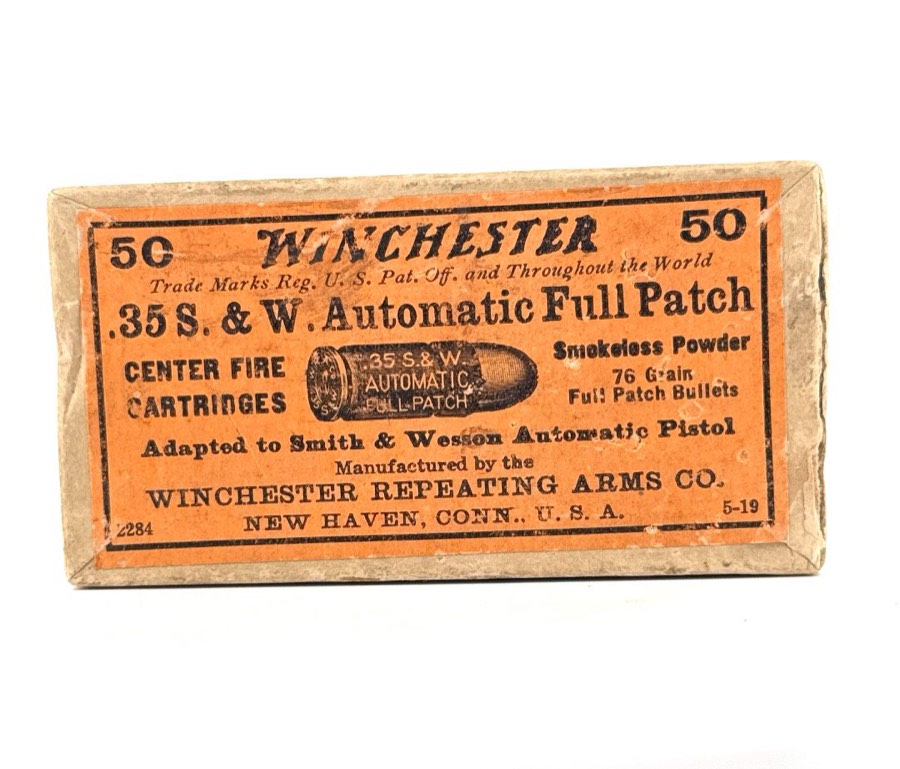
The item at a glance · read from the label
| Maker | Winchester Repeating Arms Co., New Haven, Conn. |
| Cartridge | .35 S&W Automatic, center fire, “Adapted to Smith & Wesson Automatic Pistol” |
| Load | Smokeless powder, 76 grain full patch bullets |
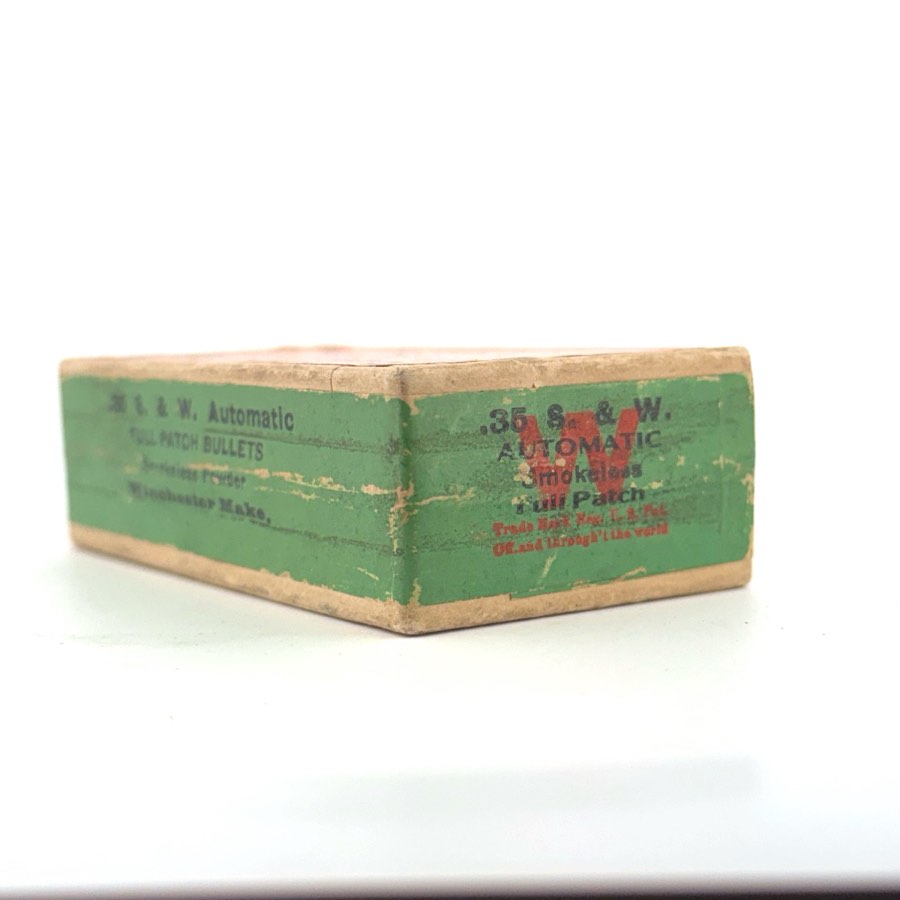
| Box | Two-piece, 50 count, still sealed |
| Corner marks | 2284 and 5-19 |
| Condition | Very good; one side sealing label bunched and damaged |
The pistol that missed
In 1913 Smith & Wesson brought out its first semi-automatic pistol, the Model 1913, and rather than chamber it for Colt’s .32 ACP they worked with Remington on a brand-new cartridge for it. The pistol was a commercial miss. It cost $16.50 when the competing Colt and Savage pocket pistols sold for $15.00, and only around 8,350 were made before production wound down around 1921. Dead pistol, dead cartridge. Ammunition makers loaded .35 S&W Automatic for the pistols already out there, and then, eventually, nobody did.
The whole life of a caliber
1912
S&W and Remington design the new cartridge
1913
Model 1913 pistol goes on sale at $16.50
~1921
Production ends near 8,350 pistols
Today
The boxes outcollect the pistol that needed them
The name oversells it
Despite the “.35” on the label, the bullet measures about .312, the same as a .32 ACP. Call it an 8mm wearing a 9mm’s name tag. The original S&W and Remington design used an unusual half-jacketed bullet, a jacketed nose for feeding over an exposed lead bearing surface. This Winchester box says what Winchester loaded instead, right on the label: 76 grain full patch, meaning fully jacketed. Same chambering, different maker, different bullet. That is precisely the kind of detail that makes box collecting more interesting than it has any right to be.
Measured, not named
Actual bullet diameter, in inches
The “.35” and the “.32” are the same hole. Cartridge naming has never owed anyone consistency.
Why a sealed fifty matters
Nobody hoarded a dead caliber. Boxes got shot up, thrown out, or left to rot in sock drawers, which is why survivors are thin on the ground. And sealed matters more here than usual. An opened box of an obsolete cartridge invites questions a sealed one never has to answer: are the cartridges original to the box, is the count right, has it been topped up from a coffee can. Sealed, the box is its own provenance. That is also why you never, ever open one.
Sealed, the box is its own provenance.And a hundred-year seal is worth more than your curiosity
Reading the small print
Two marks hide in the label corners: 2284 and 5-19. I read the 5-19 as a period date code, May of 1919, which fits a box loaded while the pistols were still being made. I have not run this one against the reference tables, so treat that as my reading rather than gospel. If your library says otherwise, the contact page is open and I will happily print the correction.
Open question for readers
One thing I have not pinned down: exactly when Winchester dropped .35 S&W Automatic from its catalog. If you have a Winchester catalog from the 1920s or 30s that lists or omits it, I would genuinely like to hear from you.
Sources & further reading
- Primary artifactThe box label itself: maker, load, bullet weight, and “Adapted to Smith & Wesson Automatic Pistol” are quoted directly from it. When the artifact and the internet disagree, start with the artifact.
- Reference siteForgotten Weapons: Smith & Wesson Model 1913 Automatic Pistols. Ian McCollum’s rundown of the pistol’s design and market failure.
- Collector forumSmith & Wesson Forum: history of the Model 1913 .35 Automatic pistol. Production figures, pricing against Colt and Savage, and the six collectible variations.
- Reference siteHistorical Firearms: S&W’s first semi-automatic pistol on the half-jacketed bullet design and the cartridge’s dimensions.
In the shop now
Sitting on an oddball caliber?
Obsolete and unusual cartridge boxes are exactly what I collect and buy. Send a photo and the story that comes with it.
Show me the box